Error Analysis

When Ownership Should Not Be Drawn as Flow

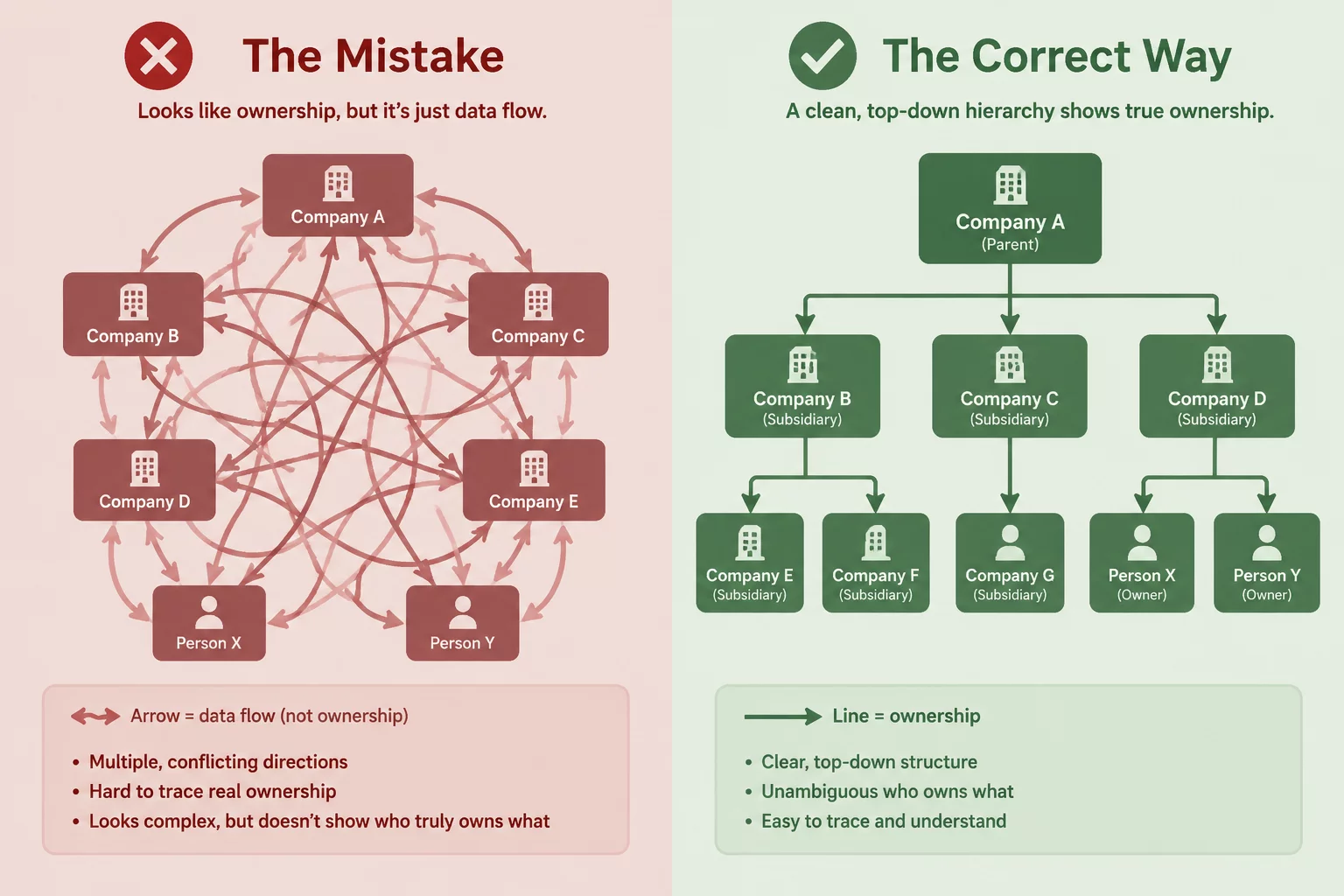
Deconstructing organizational boundary mistakes where direct lineage arrows accidentally substituted for responsibility matrices and domain boundaries.

Case Overview: The Lineage Arrow That Looked Like a Pipeline

A platform team published a system map where solid arrows ran from "Data Platform Team" to each of five services — intended to show which group owned which component. A partner engineering team read the same arrows as data flows and designed an integration assuming the platform team brokered every request through a central service that did not exist.

The error only surfaced in design review, weeks in, when someone asked which API version the "owner service" exposed. There was no owner service — only an org chart accidentally drawn in flow notation. The diagram had fused two different semantic layers: responsibility and runtime traffic.

Failure Signature: Organizational Edges in Runtime Clothing

If an arrow's endpoints are a team and a service — not two runtime components — it is an ownership relationship. Rendering it with the same stroke, weight, and arrowhead as data flow guarantees misreading.

Responsibility matrices and domain boundaries solve this without borrowing flow notation at all: containment regions, color-coded ownership bands, or a labeled "owned by" badge on each node express accountability while leaving the arrow vocabulary free for actual traffic.

Root Cause Breakdown

The failure traced back to four modeling shortcuts that are easy to make and expensive to unwind.

  1. 01
    Mixed Semantic Layers on One Canvas

    Org accountability and runtime behavior were drawn in the same notation, forcing readers to guess which layer each edge belonged to.

  2. 02
    Arrowheads on Accountability

    Directionality implied delegation of work — "team sends to service" — when the intent was stewardship, which has no direction of motion.

  3. 03
    No Boundary Containers

    Without visible domain boundaries, ownership had to be inferred from edge topology — and edge topology reads as plumbing.

  4. 04
    Phantom Infrastructure Cost

    The partner team spent design effort on an integration surface that existed only as a misread line, delaying the real interface contract by a sprint.

How to Show Ownership Without Flow Notation

Three techniques keep accountability visible while preserving the integrity of runtime edges.

First, prefer containment: draw a labeled region around everything a team owns, and let ownership be read from enclosure rather than connectivity. Second, where containment is impractical — shared services, matrixed teams — use a distinctly styled edge: dotted, muted, and labeled "owns," never the same stroke as data flow. Third, keep a legend that names every edge type on the canvas; readers should never have to reverse-engineer your notation.

The audit question for this class of error: "Does anything physically traverse this edge?" If the answer is responsibility, authority, or reporting lines — remove the arrow and reach for a boundary instead.

Topic Tags: Case Study Ownership Topology Domain Boundaries

Stay Informed on Diagram Semantics

Receive practical case studies, notation standards, and structural disambiguation guides directly in your inbox.

Related Semantic Studies

Continue exploring diagrammatic accuracy, connector disambiguation, and edge classification.