Connection Semantics

Flow Connections

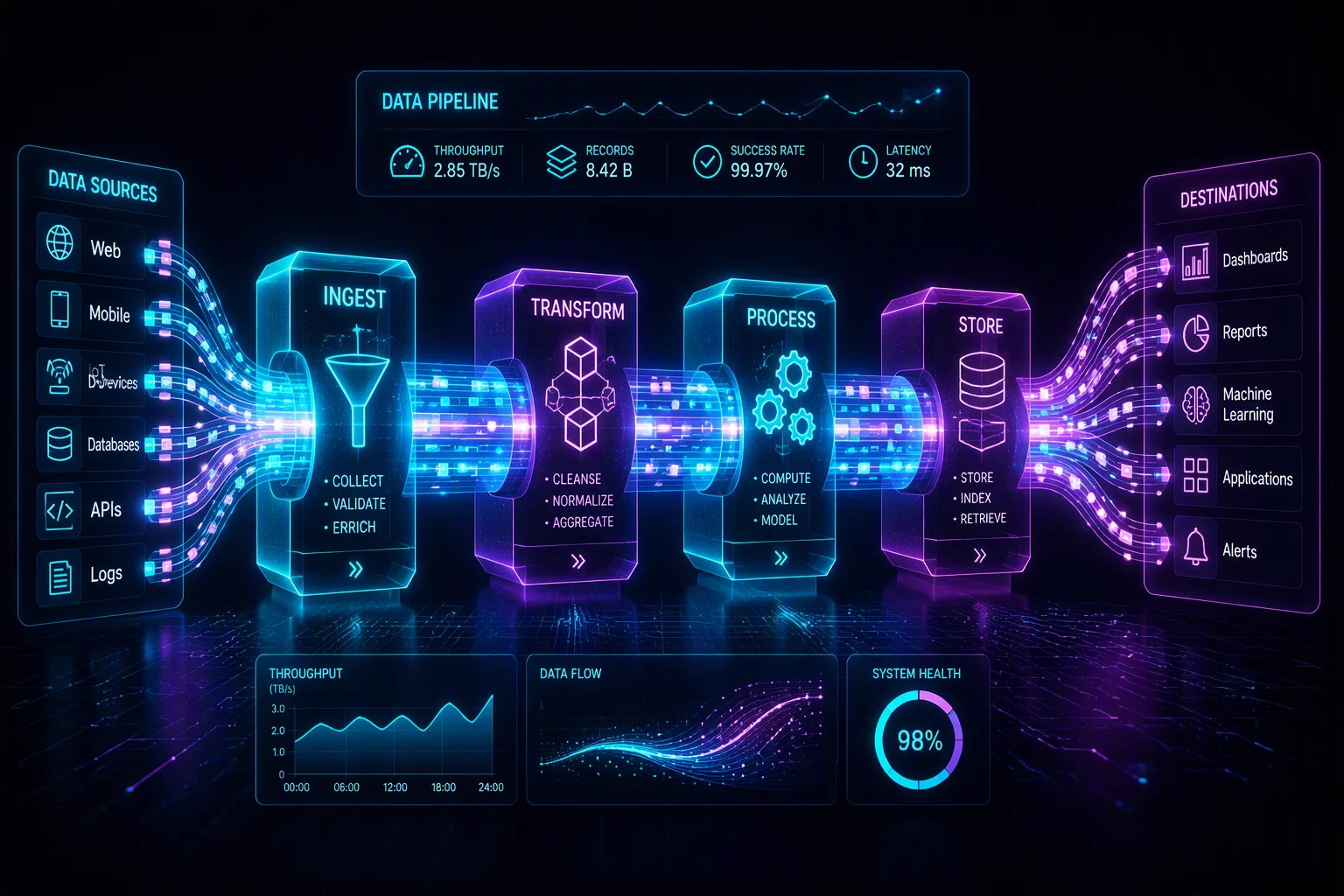
Continuous data transit and payload transmission between independent services — and why a flow edge is a behavioral contract, not a decorative line.

What a Flow Edge Actually Declares

A flow connection states that data physically moves from one node to another: bytes, events, records, or payloads cross a boundary over time. Unlike a dependency — which is a static precondition — a flow describes motion. When you draw a flow arrow between a producer and a consumer, you are implicitly asserting a transport protocol, a direction of travel, and a payload contract that both sides must honor.

The most common modeling failure is treating flow arrows as generic "talks to" lines. A reader who sees a solid directed edge reasonably assumes ordered, continuous transmission: a stream, a queue drain, or a request-response exchange. If the real relationship is a nightly batch export or a manual file handoff, the unlabeled flow arrow hides the operational truth that on-call engineers need most.

Core Diagnostic Rule: Flow Implies Movement With a Contract

Every flow connector should answer three questions at a glance: what payload travels, in which direction, and under which delivery semantics — at-most-once, at-least-once, or exactly-once.

Backpressure is the silent qualifier of every flow edge. When a consumer cannot keep pace, the connector becomes the bottleneck: buffers grow, latency climbs, and upstream services stall. Marking flow connections with expected throughput or rate limits turns a decorative diagram into a capacity-planning instrument.

Four Properties Every Flow Connector Should Carry

To make flow edges actionable rather than ambiguous, annotate each one with the operational properties that determine how the system behaves under load.

  1. 01
    Payload Schema and Format

    Name the entity or event type that travels the edge — OrderCreated, TelemetryFrame, PaymentBatch — so readers never guess what crosses the boundary.

  2. 02
    Delivery Semantics

    Distinguish streaming, queued, and request-response transports. A WebSocket stream and a polled REST endpoint deserve different visual treatment or explicit labels.

  3. 03
    Direction and Cardinality

    One arrowhead, one direction. Fan-out broadcasts and many-to-one aggregations should be drawn as separate edges, never collapsed into a single ambiguous line.

  4. 04
    Rate and Backpressure Behavior

    Note expected volume — events per second, gigabytes per day — and what happens when the consumer falls behind: buffering, shedding, or throttling.

Separating Flow From Dependency and Sequence

Flow edges are routinely confused with two neighbors in the semantic family: dependencies and sequences. Keeping them distinct is the foundation of readable system diagrams.

A dependency says "B cannot start without A" — nothing necessarily moves. A flow says "data continuously moves from A to B" while both run. A billing service may depend on a schema registry yet stream payment events to a ledger: draw the first as a dependency edge and the second as a labeled flow, and the operational picture snaps into focus.

Audit every flow arrow with a simple test: "If I cut this edge at 3 a.m., which payloads stop moving?" If the honest answer is "none — it is just a startup precondition," redraw it as a dependency. Precision here prevents engineers from provisioning queues and bandwidth for connections that were never really flows.

Topic Tags: Data Flow Streaming Backpressure Connection Semantics

Master Diagrammatic Precision

Receive our monthly field guide on clarifying architectural notation, eliminating ambiguous connectors, and designing failure-proof technical diagrams.

Related Semantic Studies

Continue exploring diagrammatic accuracy, connector disambiguation, and edge classification.