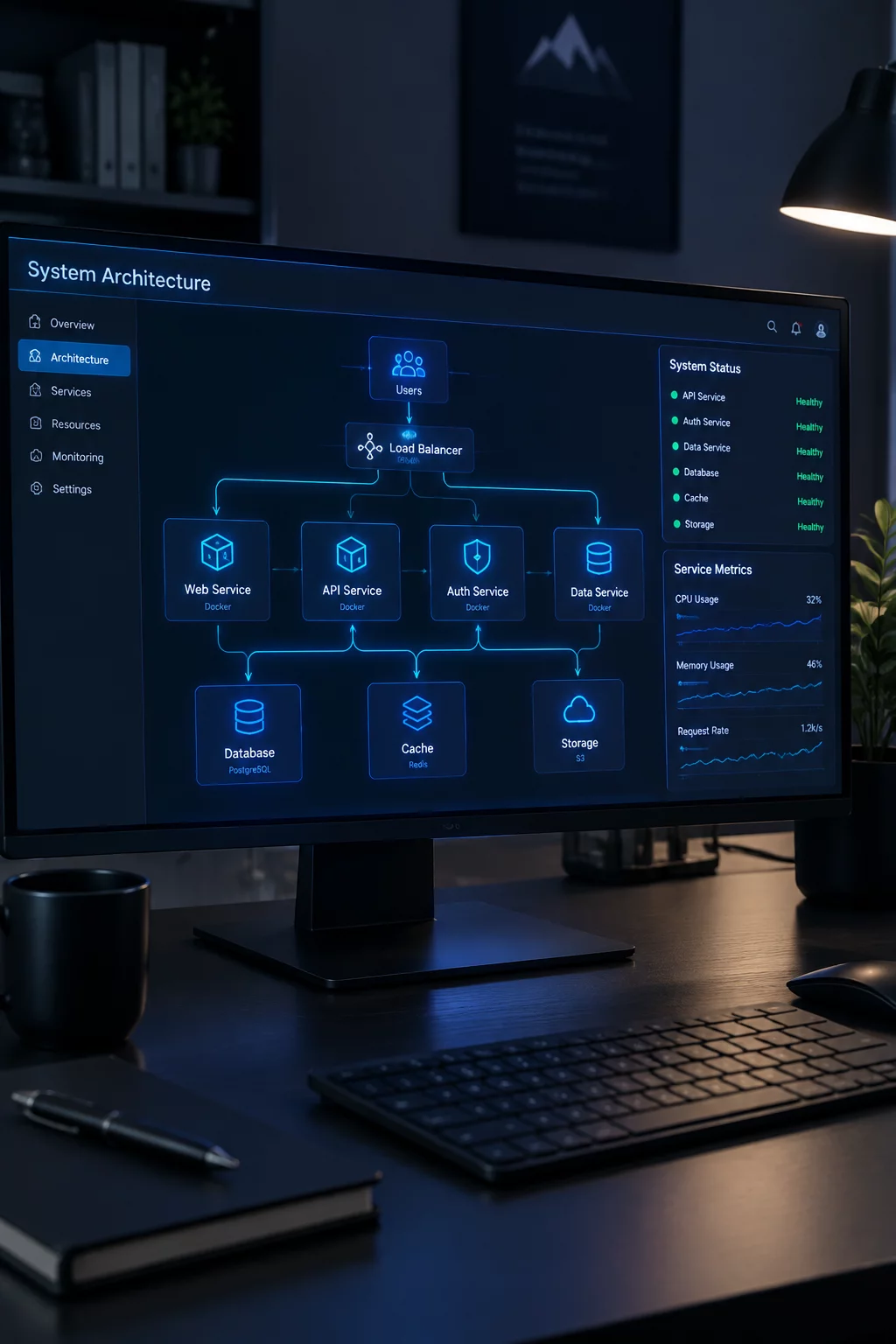
Eliminating Diagrammatic Ambiguity Across Systems
ConnectorIntent Atlas was founded to solve a pervasive structural failure in technical documentation: the unexamined arrow. Across architecture diagrams, data pipelines, and workflow blueprints, lines connecting components are routinely drawn without explicit operational semantics.
When an engineer inspects a line between two nodes, the fundamental question must always be: What Does This Connection Actually Mean? We provide the methodological framework, semantic taxonomies, and diagnostic criteria necessary to convert vague sketches into deterministic engineering blueprints.
Core Semantic Axiom
A connection without semantic intent is a liability. Every diagrammatic edge must define data directionality, trigger mechanics, coupling rigidity, and error boundaries.
The 5-Step Material Formula
Every relational connection must pass through five rigorous analytical stages before reaching production documentation.
Isolating the Node Pair & Boundary Conditions
The analysis begins by naming and bounding the source and target entities. We establish whether the nodes represent autonomous physical systems, logical software modules, business actors, or persistent data stores.
- Explicit boundary demarcation between system zones
- Classification of actor autonomy and runtime lifecycle
Enumerating Candidate Semantic Relationships
An undirected or generic line could signify synchronous RPC invocation, asynchronous message dispatch, compile-time dependency, data ownership, or transactional precedence. We catalogue all plausible intents.
- Control flow vs. Data transfer distinction
- Coupling profile: Temporal, spatial, and synchronization modes
Extracting Evidence from Operational Context
Reviewing configuration files, network protocols, retry policies, and authentication layers to definitively disprove incorrect interpretations and prove the exact runtime interaction.
- Protocol inspection (gRPC, WebSockets, HTTPS, AMQP)
- Failure handling: Circuit breakers, timeouts, idempotent fallbacks
Contextual Evidence Ledger
Transport: TLS 1.3 mTLS via Internal Envoy Proxy
Semantics: Idempotent PUT /v2/orders/finalize with 400ms SLA
Backpressure: Client-side exponential backoff rate limiter
Applying Precise Disambiguated Notation
Replacing generic arrows with standardized syntactic glyphs and unambiguous edge micro-labels indicating protocol, synchronicity, and payload semantics.
- Standardized line styles: solid, dashed, stroked, double-headed
- Explicit verb-noun edge tags avoiding overloaded jargon
Documenting Residual Ambiguity & Fallback States
No diagram covers 100% of real-time state space. The final stage notes edge boundary conditions, failover degradation modes, and undocumented assumptions directly alongside the relationship.
- Degraded state behavior during upstream partitioning
- Assumptions regarding network partitions and clock drift
Residual Ambiguity Record
Cross-region latency spikes over 800ms trigger asynchronous reconciliation queue instead of inline rollback.
Who Relies On Connector Semantics?
Clear diagrammatic grammar bridges the gap between executive product roadmaps, rigorous system architecture, and operational reliability.
Business & Systems Analysts
Translate domain processes into formal handoffs without confusing trigger events with data transformations.
Software Architects
Architect resilient distributed systems by distinguishing blocking network calls from decoupled event streams.
Product Managers
Clarify cross-service dependencies and functional boundaries without getting derailed by mislabelled user journeys.
Engineering Teams
Eliminate deployment surprises, ambiguous contract handshakes, and unhandled microservice error cascades.
Operations & SRE
Identify single points of failure, unmonitored backpressure links, and cascading dependency loops in minutes.
Process Designers
Model human-in-the-loop approvals, escalation triggers, and synchronous business rules with zero notation drift.
Computer Science Students
Master software design principles, enterprise integration patterns, and UML/C4 modeling standards effectively.
Security Engineers
Expose implicit trust assumptions, unauthenticated edge transitions, and cross-boundary data leakage risks.
Explore the Complete Atlas Knowledge Base
ConnectorIntent Atlas operates as an open technical reference guide. Traverse our structured guides to master notation primitives, semantic edge taxonomies, and systematic error triage.