Notation Basics

Why Two-Way Arrows Create False Symmetry

How bidirectional connectors mask power imbalances, asynchronous feedback, and divergent semantic protocols in system diagrams.

The Illusion of Mutual Equilibrium

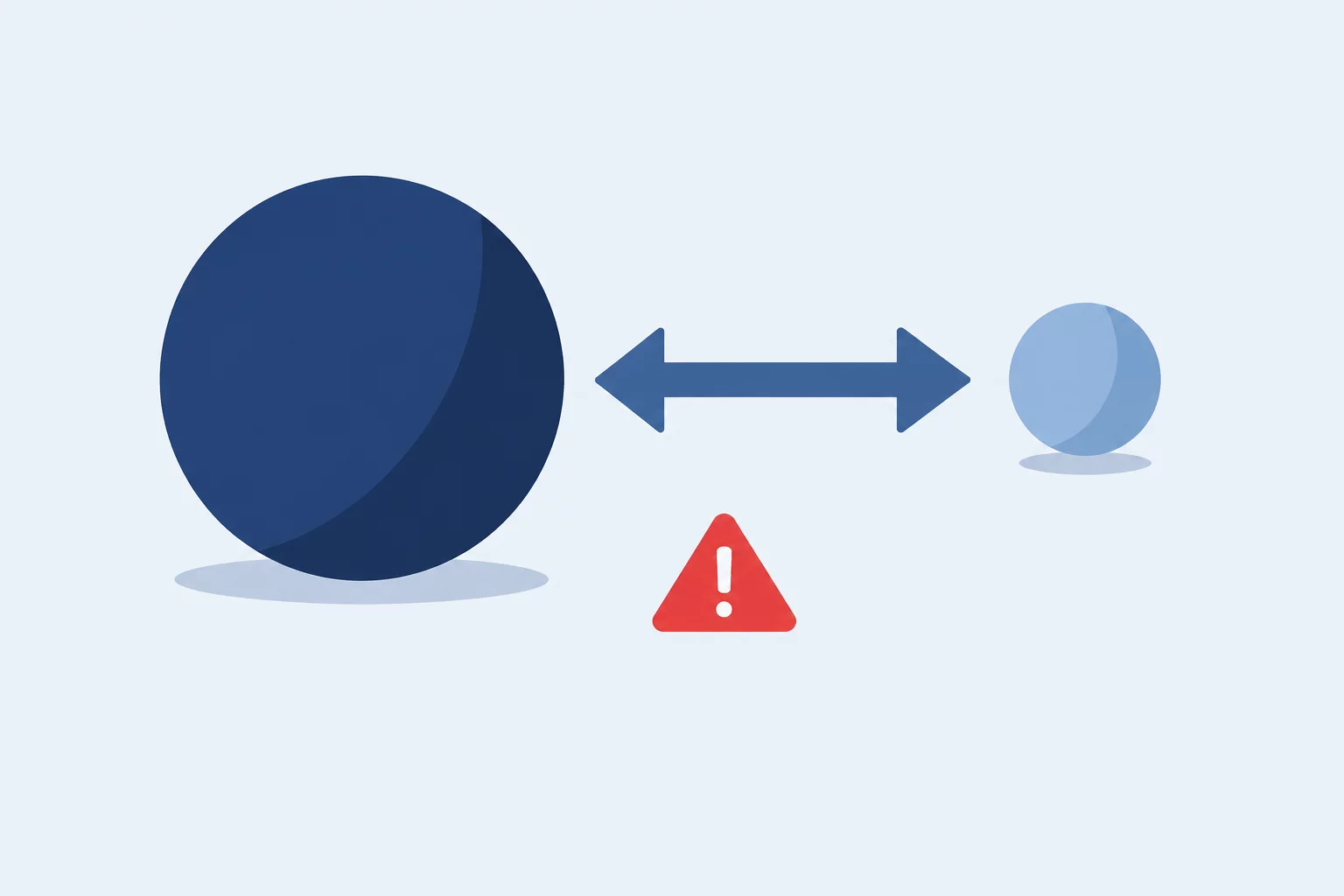
When diagram authors draw a line with arrowheads at both ends, they usually intend to communicate mutual interaction or reciprocal communication. In practice, this shorthand conceals distinct operational mechanisms. A two-way arrow creates an immediate optical impression of equal partnership, balanced data exchange, and uniform operational velocity between two components.

Real architectural relationships rarely exhibit true symmetry. One entity typically initiates requests while the other responds; one component holds authoritative state while the other receives downstream cache updates; or one node emits event streams while the other executes reconciliation loops. Collapsing these independent directional flows into a single double-headed edge flattens protocol boundaries, hides systemic dependencies, and obscures failure cascades.

The Diagnostic Symmetry Test

If reversing the roles of Node A and Node B changes the protocol payload, frequency, latency tolerance, or failure impact, the connection is asymmetric. It must be represented as two distinct unidirectional connectors with explicit semantic labels rather than a single bidirectional arrow.

Diagram consumers naturally infer that if Component A can trigger Component B, the reverse holds with equal authority and semantics. In production incident reviews and architectural audits, this false equivalence regularly misleads engineering teams into underestimating cascading bottlenecks and single-point-of-failure vulnerabilities.

Four Structural Hazards of Bidirectional Connectors

Replacing bidirectional lines with discrete directional vectors exposes hidden architectural friction across four essential operational dimensions:

  1. 01
    Confusing Request and Response Payloads

    A client sending a lightweight query and a server returning a heavy dataset perform two radically different transfers with unequal throughput and timeout characteristics.

  2. 02
    Concealing Asymmetric Failure Domains

    When Node A halts, Node B might degrade gracefully, whereas Node B stalling could immediately crash Node A. A bidirectional arrow suggests mutual resilience.

  3. 03
    Masking Unequal Control Hierarchy

    Management planes issue commands while worker planes report telemetry. Conflating command orchestration with telemetry streaming creates false peer-to-peer assumptions.

  4. 04
    Obscuring Temporal Asynchrony

    Real-time triggers flowing rightward paired with delayed nightly batch updates flowing leftward share no common clock, defying unified edge representation.

Disambiguating Bidirectional Relationships

System clarity improves immediately once authors eliminate two-way arrows in favor of explicit paired connectors.

Applying explicit directional notation begins by separating the control channel from the data return channel. Rather than drawing a single line between an authentication service and a web client, precise diagrams show one arrow for credential transmission and an opposing arrow for token issuance, each carrying its specific payload type and SLA expectation.

Documenting distinct protocols per direction prevents ambiguous technical discussions during implementation phases. Engineers can verify authentication retries without confusing them with keep-alive heartbeats, ensuring system behavior matches diagrammatic specifications across every integration point.

Topic Tags: Bidirectional Edges Asymmetry Diagram Semantics Protocol Clarification

Master Diagram Semantic Precision

Receive rigorous architectural critiques, connector disambiguation guides, and visual notation patterns directly in your inbox twice a month.

Related Semantic Studies

Continue exploring diagrammatic accuracy, connector disambiguation, and edge classification.