Error Analysis

When a Dashed Line Means Too Many Things

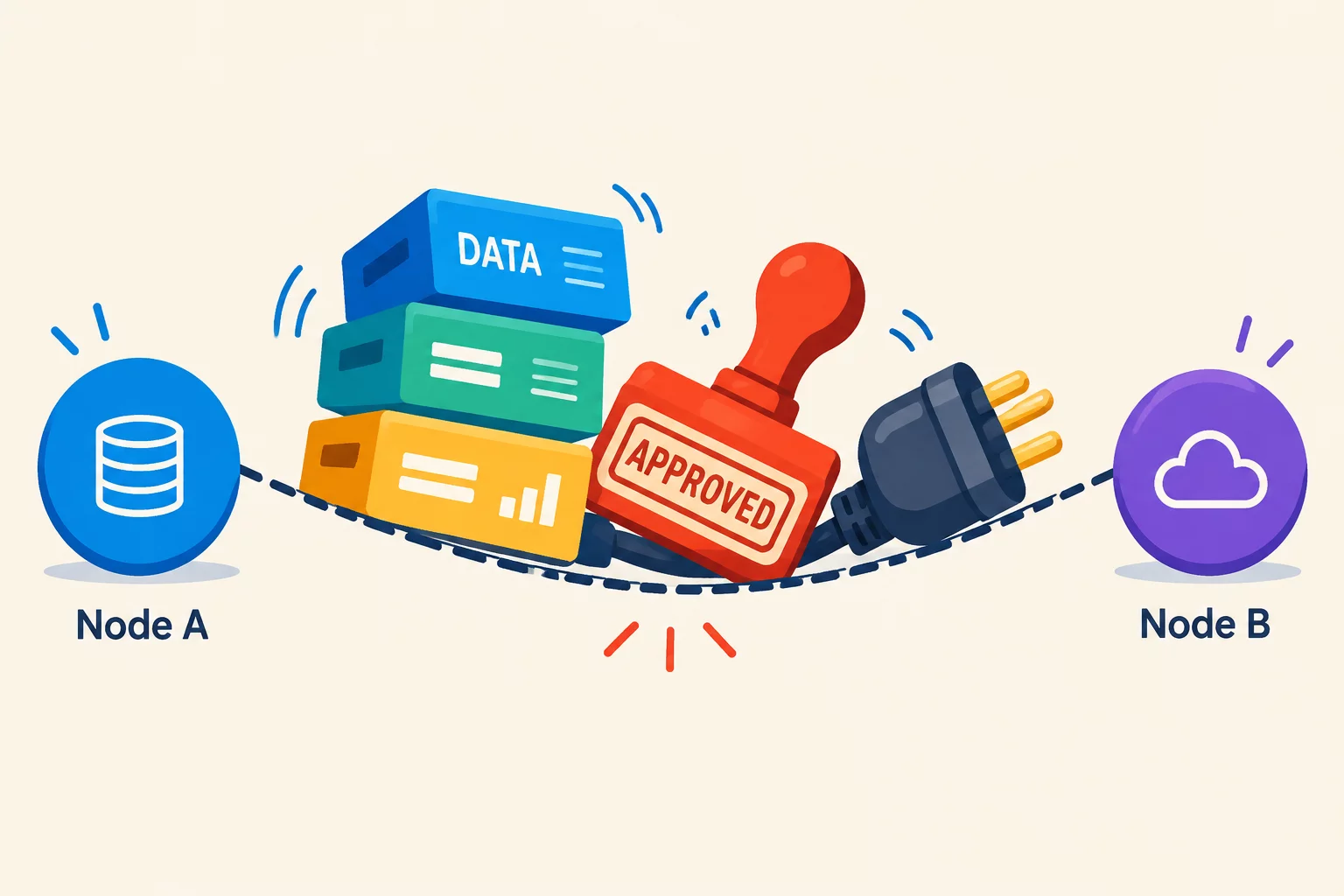
Overloaded stroke styles conceal distinctly different relational behaviors behind an identical visual convention.

The Overloaded Stroke Dilemma

Diagram authors frequently default to dashed or dotted line patterns whenever a relationship feels secondary, asynchronous, optional, or informal. Over time, this single visual pattern absorbs mutually contradictory operational meanings across system architectures and organizational charts.

In enterprise models, a dashed line can simultaneously represent an asynchronous message queue, a conditional approval escalation, an indirect compile-time dependency, or an informal advisory reporting line. When readers examine identical dashed connectors linking adjacent nodes, they are left guessing whether the link implies chronological execution, physical data transfer, or administrative context.

Diagnostic Framework

Two Connected Nodes → Identify Plausible Relational Meanings → Inspect Surrounding Technical Evidence → Apply an Explicit Semantic Label → Eliminate Lingering Operational Ambiguity.

Resolving this issue does not require inventing dozens of esoteric stroke styles. Instead, effective diagrams reserve dashed lines for one strictly defined semantic role and rely on explicit action labels, directional markers, or layout hierarchy for all other interactions.

Four Contradictory Meanings Forced into One Style

Engineering teams regularly compress four incompatible relational categories into the exact same dashed line syntax:

  1. 01
    Asynchronous Flow vs. Synchronous Execution

    Architects frequently use dashed lines for event-driven pub/sub messaging, yet readers often mistake them for optional or low-priority synchronous RPC calls.

  2. 02
    Conditional Branching vs. Guaranteed Sequence

    Process designers dash lines to indicate an exceptional fallback path, creating uncertainty over whether the step is optional, mandatory on failure, or non-blocking.

  3. 03
    Indirect Dependency vs. Active Runtime Interaction

    A dashed connector between services may represent a shared library dependency rather than live traffic, misleading on-call engineers during incident troubleshooting.

  4. 04
    Informational Reference vs. Governance Oversight

    Management flowcharts often use dashed borders for dotted-line reporting, creating confusion when placed adjacent to operational execution handoffs.

Disambiguation Strategies and Best Practices

Restoring clarity requires establishing explicit diagramming standards that separate intent from aesthetic decoration:

Define a clear notation legend before sharing system architecture documents. If dashed strokes represent asynchronous event publishing, keep solid strokes for synchronous request-response cycles and utilize distinct container boundaries for organizational ownership. Never leave connector semantics to reader intuition alone.

When a connection carries a nuanced responsibility, attach an explicit verb phrase directly to the line, such as 'publishes event to', 'validates against', or 'governed by policy of'. Explicit textual qualification immediately resolves visual ambiguity and turns diagrams into dependable technical specifications.

Topic Tags: Diagram Semantics Connector Intent Error Analysis Architecture Modeling

Master Diagram Semantics

Receive comprehensive analyses of diagrammatic patterns, connector classification frameworks, and precision modeling guides.

Related Semantic Studies

Continue exploring diagrammatic accuracy, connector disambiguation, and edge classification.