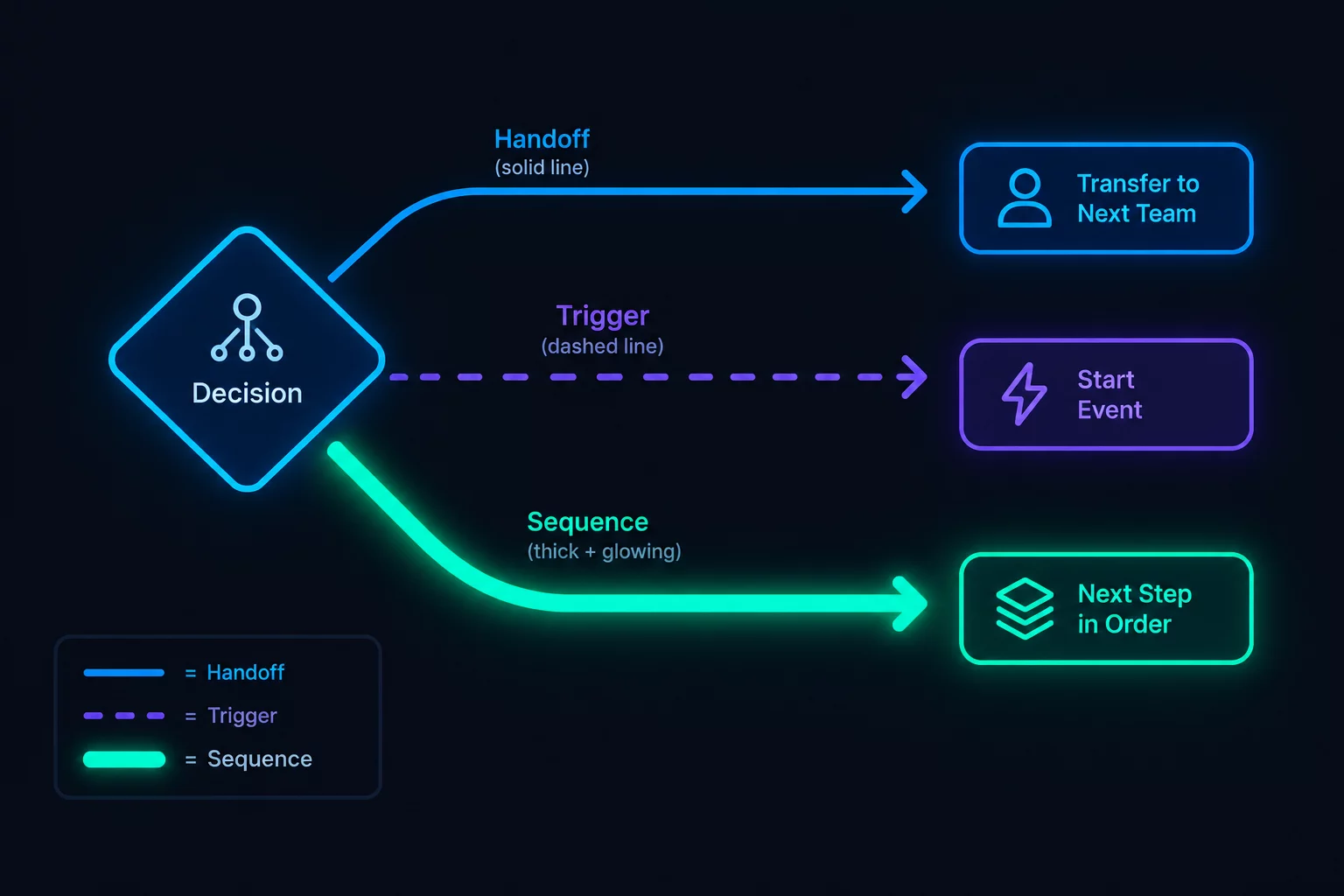
The Illusion of Uniform Sequence in Workflow Diagrams
Process diagrams frequently collapse three fundamentally distinct operations into a single generic arrow labeled "Next" or left unlabelled. Teams assume everyone understands what happens when Step A completes. In reality, one outgoing path represents a physical artifact handoff, another signifies a chronological milestone sequence without active transfer, and a third operates as an asynchronous event trigger. When these three mechanisms share the same visual representation, software engineers, operational managers, and compliance auditors interpret execution boundaries in incompatible ways.
The core breakdown happens because standard flowcharting conventions rarely enforce semantic precision on connectors. In a production release workflow, for instance, a step labeled "Run Automated Test Suite" connected by a plain arrow to "Deploy to Staging" implies immediate automated invocation. Yet the very next arrow connecting "Deploy to Staging" to "Notify Product Owner" is purely informational, while the arrow leading to "User Acceptance Testing" implies an active manual transfer of responsibility. Treating all three transitions as simple sequential flow obscures latency, error handling protocols, and ownership accountability.
Core Diagnostic Formula: Disambiguating the Next Node
Two Nodes → Possible Meanings → Evidence From Context → Better Label → Remaining Ambiguity. When an arrow simply implies progression, test whether execution halts until acknowledgment, whether an artifact moves across a team boundary, or whether an event is broadcast asynchronously.
When downstream teams interpret an informational trigger as a blocking handoff, processes grind to a halt waiting for explicit confirmations that never arrive. Conversely, when an active operational transfer is mistaken for a non-blocking sequence, downstream actors fail to take ownership, causing dropped tasks and unresolved deployment failures. Disambiguating these three forms of transition directly within the visual syntax eliminates operational guesswork before execution begins.