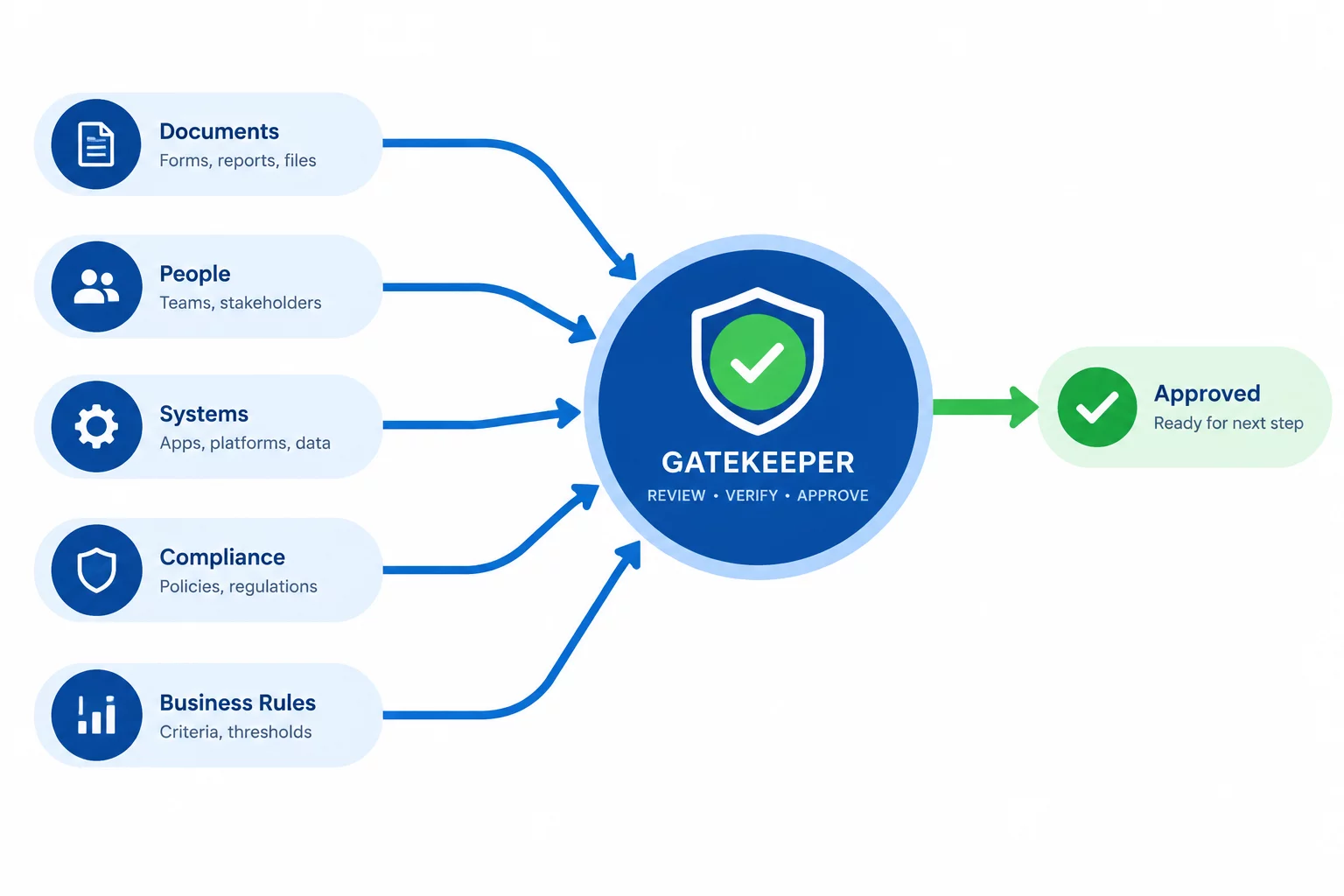
The Edge That Blocks Until Someone Says Yes
An approval connection is not a data path — it is a gate. It declares that work in progress may not cross from one stage to the next until an authority grants permission: a manager signing off on a purchase order, a compliance officer releasing a deployment, or a quorum of validators accepting a transaction. The edge represents a decision point, and decisions can be refused.
Treating approval gates as ordinary flow arrows erases the most important property of the boundary: it can halt. A reader who sees a plain arrow assumes automatic progression. When the real system parks requests in a review queue for days, the diagram lies about latency, ownership, and failure modes all at once.
Core Diagnostic Rule: An Approval Edge Must Name Its Gatekeeper
Every approval connector should state who or what grants passage — role, committee, policy engine, or consensus protocol — and what happens on rejection: return, escalation, or termination.
Cryptographic consensus is the machine analogue of the human signature. When a commit requires quorum approval, model it with the same gated-boundary semantics as a manual sign-off: a threshold of authorities, a waiting state, and a rejection path. The notation differs only in who holds the stamp.